Thursday, February 26, 2009

Visualization: Severe Storm & Jane Richardson

Both the Severe Storm visualization and molecular visualizations that Jane Richardson showed were good representations of how modeling techniques have changed over time and improved to present information more accurately in different ways. However, especially in the early 1980s version, the Severe Storm model did not make the information as comprehensible and immediately explicit, and the molecular visualizations better portray data. Visualizations now are able to be modified immediately through the same system, to make them more and more accurate, like Richardson showed when fixing the incorrect positioning in a molecule.

Simple things like this had to be very much changed in the first version of the Severe Storm visualization, such as the scale, compass, and the rainbow spectrum, which affected reflectivity and the way we perceived the information shown and the depth of the grid/visual. The high/low contrast also demonstrated the difference in portraying primary/secondary information. This was done much better in the second version of the Severe Storm than the first. Similarly, with 2-D versions of molecule models, it was difficult to gain an idea of the complexity and depth through these systems as is possible in the 3-D versions, but in print it also made it easier to view in 2-D, making this version not totally void.

While the Severe Storm video was aimed at showing the progression of a storm and replicate it, the molecule models actually took data and analyzed and modified the molecules as necessary with changes in science. This allows the visualization to be changed as needed, unlike the storm video which was just the same things repeated without the ability to change. Computers are now much faster and able to do things that we didn't use to be able to, and with more precision. Jane Richardson explained systems such as third party software that enhance the information through more accessible and clear looks at the information such as the molecule models, which is what allows the modification to be done in real time. As Jane Richardson shows, to use metaphors to analyze and understand data through visualizations is very effective, and is a different approach than that of the Severe Storm visualization, in which nothing is really learned, but instead just shown repetitively.

Monday, February 23, 2009

Margaret Livingstone & Color/Perception

I thought Margaret Livingstone's speech was really interesting, because it pointed out a lot of aspects about color/visuals/perception in terms of images that I come across daily that I didn't really think about. For both mosaics and optical illusions/abstracts, it was interesting to hear about in terms of what we process first and how it all fits together to still create the main picture. 

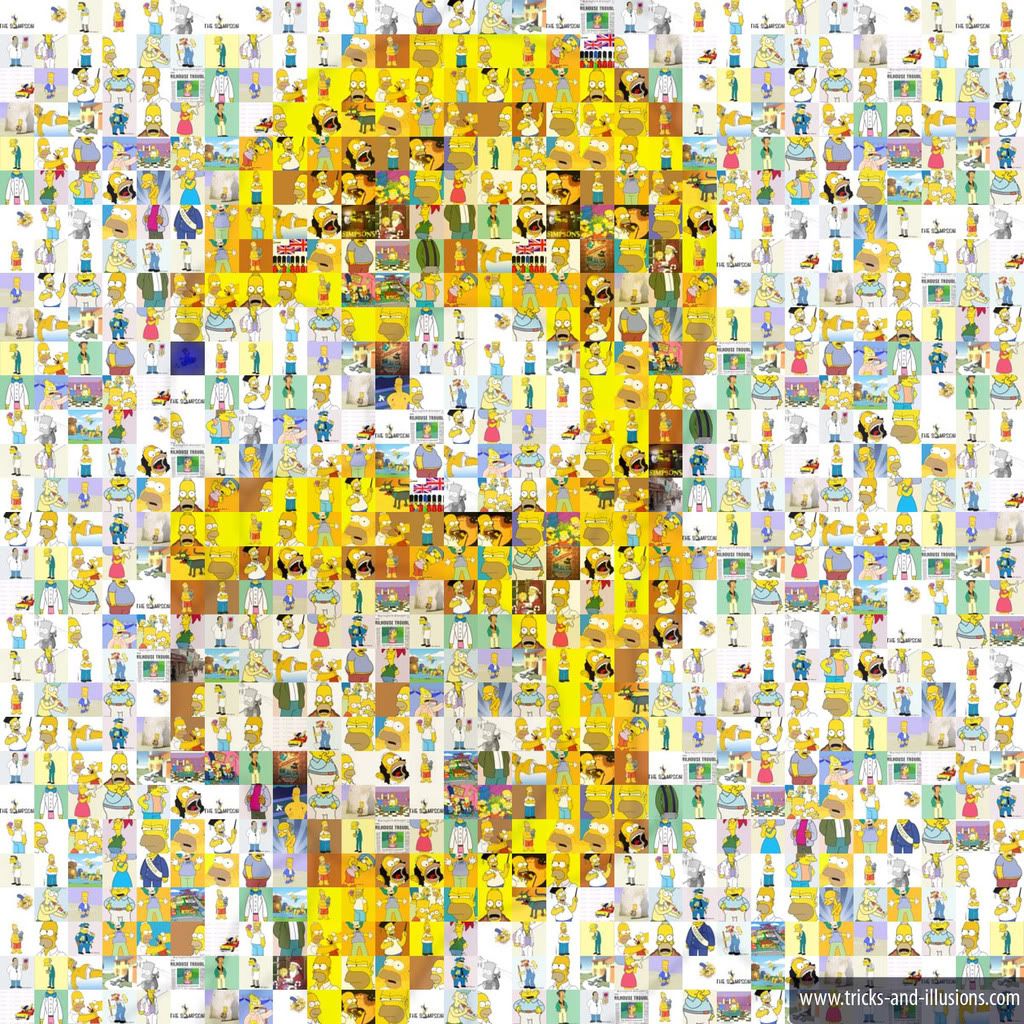
This picture of Homer Simpson surrounded by many other smaller pictures is similar to many mosaics of great people, including Babe Ruth like Livingstone showed, and shows how our peripheral vision (with low resolution) and central visions (with high resolution and more detail paid attention to the center) work to perceive the individual snapshots separately from the bigger, macro portrait of Homer. 

Closely related to this is the idea of optical illusions, and somewhat related to the 3-D images that Livingstone discussed. The way we perceive the colors and depth of these dice is different depending on what angle we look at them from, the colors used, in this case, the stark contrast of black and white, the background they are on, and the shadow it creates. We saw examples of these illusions in class as well, and some are more abstract with just colors and shapes, where others can be actual objects that deceive us. With color illusions, what we see is more an illusion of motion, while with objects such as the dice, the illusion is one of depth and 3-D.

Thursday, February 12, 2009

WISER/Sherryl Broverman

First off, I think that the whole idea and perspective of WISER is great with a great intiative and idea/mission. It touches so many aspects that are important to girls and women growing up in Africa (specifically Kenya), which in turn affect the society as whole. It's great that people are the world are working to want to improve places that they may have no direct connection to, but still want to see succeed. This is especially true because especially in areas such as Nyanza, women do not have as prominent a role in society, and to be able to help them achieve better lifestyles, become literate, healthy, etc. is important. At the same time however, it will probably take more than just one organization, and one girls' school, and the start-up money they have to help the situation, especially in the poor, male-dominated region, but it is definitely a stepping stone that has an impact.

I thought Sherryl Broverman's lecture was really interesting, especially in noting how Kenya is very technologically advanced in many ways, for being as poor as it is and not having some basic necessities. It just kind of shows how priorities have changed these days. However, this is mainly the case for males - women in Kenya (and much of Africa) don't receive the same privileges, which is where WISER steps in as a way to make things more available to women and equal. As Ms. Broverman said, trying to do this - to make women aware of political issues, health issues, economic issues, etc., through introducing and allowing women access to more technology, is an effective way to do so because of the pace at which things are changing not only in Kenya, but worldwide. I also thought that websites with different initiatives such as Ushahidi.com to be updated and connected to others, and Kiva.com where people all over the world can donate money to help advance Africa, were other sources that could be very beneficial to the process. I think that one of the biggest things I took away from the lecture is how much we take technology for granted here (in the U.S.), by seeing how it is so empowering in places like Kenya, especially in terms of gender roles between men and women, and how it is beginning to change so many aspects of society for these people, whereas here we are "behind" if we aren't already adapted to it.

Wednesday, February 11, 2009

Medicine in Technology/Mark Olson

I thought the connection this week between information technology and medicine, both through the articles we read and through Mr. Olson's lecture were really interesting and sparked some ideas I hadn't really thought about before. The idea of robots taking on the roles of doctors and nurses to advance medicine and health in replacement of humans, and even surpassing the skills that humans have is both cool and scary. On one hand they are able to do things just as, if not more, efficiently and accurately than human doctors. On the other hand, while these robots can take on more than humans may be able to, they cannot adapt to a situation, and therefore if something goes wrong or there is something they are not programmed for, it could turn out with really bad results. Also, the robots themselves are not fullproof and could therefore malfunction themselves, which could also have a negative affect through their medical procedures. 

Mr. Olson's discussion of the Da Vinci Surgical System was cool because it expanded on what I have heard of on the technological advancements in medicine and computers as doctors thus far. There are clearly many benefits to having robots/machines performing the procedures and medical assistance, but I am not sure that they should be the only option in the future - working in tandem with human doctors is necessary, not only for personal contact but also in the event that the robot may be unable to function if something goes wrong, or fix something if it goes wrong. At the same time, the skills (and knowledge) of the human doctors will decrease, because they won't have to know these things off the top of their heads any longer, and eventually may not be needed at all - which could be very bad for employment purposes! However, it may also open up different opportunities, both in terms of jobs, where new ones will be created to adapt to the new technology, but also in having the ability to perform surgeries worldwide without having to be present. I think that there are a lot of possibilites that open up with the introduction of robots and machine-performed surgeries in the medical field, but at the same time I don't think we should rush right into it because there are many risks and consequences that come with it.

Wednesday, February 4, 2009

Virtual Peace/Patrick Herron

I thought Patrick Herron's lecture was really interesting and his work with Virtual Peace was really intriguing. I was kind of unclear at first about the purpose of Virtual Peace and what kind of impact it has as a virtual space, but after hearing the lecture and other points Mr. Herron brought up I think it's a really good idea. Mr. Herron's explanation/thoughts on simulation vs. reality were also interesting (a little confusing at first) but he did make good points with good evidence to back up that convinced me! I think that having simulations like Virtual Peace, that are educational but still engaging and still "games," make them more appealing. I also think that they are better than the paper-based version like Mr. Herron was saying, because it allows students to get other input and ideas, interact, and not just have set instructions, rules, and thoughts on paper. 

The fact that it can provide the future generations, but also adults now, with ideas and real-life situations on issues in the world can really help for future conflicts, so I think that's a big plus. I think having more conflicts and issues other than one focused on Hurricane Mitch, but for other current problems today as well as past ones would really be beneficial to learning. It might be cool to maybe try a more broad-based simulation that can accomplish this, for various conflicts, which would allow everyone around the world to interact and get all sides of the conflict involved, for example with the Israeli-Palestinian conflict, or the War in Iraq. The problems of time and money come into play too with this however, so I don't know how realistic/plausible it would be. 

--

Playing with Virtual Peace today was pretty cool, but a little different than I expected. I guess because we were just playing around with it and not using it for the "intended" purpose exactly, but I still thought it was a cool idea. If I were to play it for a class it would be a lot more interesting and engaging, and I think I would really learn a lot along the way. It is definitely much more engaging and fun, especially for our generation, to learn through simulation, and actually doing, than just reading and listening. It was funny to play that and then Second Life right after, seeing how the overall "world" compared to this simulation for a conflict in the world. It was also cool to see how everyone was interacting and how they recreated themselves in this virtual world, whereas in Virtual Peace it was a very professional and preset. Overall I thought that using both simulations was a cool exploration to show where the digital culture is shifting and becoming more user interactive, 3-D and influencing future decisions.

Sunday, February 1, 2009

Guest Speakers & Metaverse/Second Life Articles

I thought both the two guest speakers this week were really interesting and brought about cool ideas that we hadn't really seen/considered yet in class. The GUIs that Mr. Lombardi discussed was interesting because I didn't really know much about it or really consider it. The Colbalt/Croquet 3-D Internet project that Mr. Lombardi showed us was cool, but perhaps a little impractical for the future. It's cool though that not only because it would be able to connect users all over with more up-to-date information and just more efficient overall, plus it makes it more personal - at the same time though, people might not like this because it gets more invasive of their privacy and exposes their identity, and it also creates a lot more extra information to be sorted through. People might also feel they can be just as personal with webcams, audio programs, etc. But then again people also like being more involved and being able to re-create themselves online as an avatar in another "world," etc. is appealing. I also think however, that avatars are used more for people who have a lot of time and like the more video-game aspect of spaces like Second Life, and therefore like the fact that things are in 3-D and seem more "real" then just normal internet surfing of websites and games. I think it's also a cool idea, yet again a little unpromising for the future, that companies are starting to make virtual worlds for their companies, because in a way it's just like advertising but in a more interactive, personal way, which appeals to people - especially those with a lot of time surfing around. Mr. Seaman's lecture was also interesting because it showed another different side to virtual spaces but in terms or art/literature, and how these are combining. The combonotoric systems and recombinant poetics and the way that's changing the way we interact with art and was cool and something we hadn't really seen yet so I thought that was interesting as another aspect to how we are getting more interactive with technology.