Furthermore, the fact that companies are "owners" of people's DNA seems to place a sense of hesitancy upon people in supporting this new business of genotyping and mapping, along with the fact that many people are not as willing to want to know so much detailied information about their health. The future that is predicted by genotyping could possibly change, but with the knowledge of the information given by these companies, peoples' lives will be completely altered, living in response to their assessment of health. Also, the fact that DNA would be so easy to test in the future and thus affect people's relationships with one another is a consequence of this technology. I think that, as Furey said, the fact that these companies are so heavily pushing this research in an area that is relatively new, it makes it hard to be a sustainable and effective business until further into the future when there is more secure knowledge and information available.
Sunday, April 19, 2009
Genomics: Terry Furey
Terry Furey's lecture gave us more insight on genomics - genotyping and mapping of it, its uses and implications, how it affected healthcare, etc. - and also how this translates over to businesses. Companies such as 23andMe and Decode expand on the idea of personalized medicine and how our technology would affect this. This includes the idea of these companies being able to genotype someone to determine probability of health conditions and diseases in the future. This is effectively done now by tracing family history, which is cheaper and does not have as many factors taken into account as when dealing with technology. There are many limitations, including uncertainity of environmental affects and accuracy of machinery, when dealing with genomics and technology that make it more difficult, and thus more expensive, to determine these conditions. Therefore, the costs seem to outweigh the benefits of these companies' testing processes.

Wednesday, April 8, 2009
SL: Commercial Enterprise
Dorian Day Spa: http://slurl.com/secondlife/Bounty/124/199/21
This virtual space is a day spa with almost every amenity you could imagine having at a real one. The place is very high end, and each service offered is pretty expensive, which makes it geared toward richer people, mainly women, who look to pamper themselves with the best of the best. The atmosphere of the spa is soothing and exactly what people look for in real life for when they go to a spa that costs a lot of money. There are also special services offered that cost more or that are only available for a short time, in order to make people feel like they are receiving great deals or exclusive offers. There are areas where people can just lounge around without having to partake in any of the services.
As the services offered are high end, the target costumer for this is rich people, mostly women, who enjoy going to the spa and using the services offered. Women especially often feel the need to pamper themselves in real life, so the virtual simulation of this in Second Life makes it appealing to users. Also, because it is one of the more serene calming spots for people to relax other than an actual island vacationing spot, it appeals to people to go there. The design of the spa is also made to appeal to people more than other islands available on Second Life.
Sunday, April 5, 2009
Legal Implications: Smith & Jenkins' Lectures
In all honesty I knew that there were many laws and rules for what could and could not be published, posted online, copyrighted, etc., but I never really realized just how strict these laws are and how much they affect the ability of people and companies to create different things and put ideas out there that are their own, but may be very similar to others' work or unable to expand on something, etc. IP owners have an enormous ammount of say into what can be used/copied/developed, etc., that it holds back others from being able to, or even wanting to, work on something for fear that they will be sued, shut down, etc. This fear to be creative has stifled many projects that might have otherwise been successful.
It seems as though it is almost impossible to come up with something entirely one's own, because of all the complex technicalities in these laws and the fact that what something thinks is completely innovative, might be infriging on one aspect of another's work. It's almost as if, in trying to protect people's rights, they end up really having none at all in the end. Also, as both Smith and Jenkins explained, many of these laws are not "up-to-date," in that they were created before the use of computers and other technology became so important and widely used. This has affected so much of what we see on the web and elsewhere. Since technology is so important now, especially with social networks and the fact that everything is shared worldwide, copyright law and other legal issues go against this key factor of computers, the internet, and other technologies. Therefore, although it may not completely be stifling creativity, it does seem to make people hesitant in trying to be innovative and start something new, just because there are many complications and long processes involved in trying to share their ideas and obtain others'.
Sunday, March 29, 2009
Don Fowler & TWIT
Don Fowler's presentation on IT consulting was really interesting, because I always thought I knew what it entailed, but there are many aspects that he presented that I never really considered. The fact that what an IT consultant does now used to be done by others such as accountants, shows just how important technology is to businesses now, such as Accenture. There is so much we do online now through the use of the digital world that IT consulting provides many opportunities and paths, and the ability to use information technology for all of these businesses to operate more efficiently is very effective.
Also, one of the interesting aspects of the field that Mr. Fowler pointed out was that IT consultants are needed at all times, both economically good and bad, and cannot operate without computers, which are the basis for the job. IT consulting also offers many options within information technology, making it an option for various types of tech-savvy people. Mr. Fowler also touched on outsourcing and moving these jobs abroad, because of the cheaper labor, but also because technology has made it easy to communicate and operate from all over the world and with different clients. I think this is one of the especially important aspects of info technology, because not only were we at first connected with our computers to more sources, but now the ability to do this anywhere and in any capacity makes it even more powerful.
I thought the issue of newspaper/print publishing in This Week in Tech was really interesting. It's obvious that as more and more data, books, and other information moves from print, to print and online, to just online, that newspapers and books will no longer be as widely used and primary sources. People receive their information online in a faster way, and also in most cases are able to get this information for free. Also, with the ability of users online to publish their own information, more and more becomes available online, offering more perspectives. This has therefore led to a decrease in the number of jobs available for those working in the print publishing industry, and also in the importance of their jobs.
Online sources make it much easier to look for whatever the user is interested in, given the chance to bypass whatever they feel is unimportant, which is often much harder in print sources. Many people on the other hand do not want to look at a screen all day and like to see the new things they might have otherwised missed online, through print books and papers, as well as just be able to physically have these things (although still others do not like to take up space with all of these books and papers). People also feel that we are wasting paper by keeping so much in print, which is a valid point if we are trying to "go green." Many may only want to read one article and then throw away the rest of the paper, which is where the internet can minimize this significantly. Also, with the fact that information is become so portable, with the ability to get it on our phones and laptops wherever we go, people can have what they want right away, and not have to wait for a copy of an article or book to get to them. Therefore I think that with the way things are going, even if there are benefits to having things in print, soon enough everything will be online for us and paper versions will completely fade away.
Friday, March 20, 2009
Virtual Reality & DIVE
After hearing the lecture in class and going to the DIVE I realized how many different kinds of (important) real world applications virtual worlds have. The way in which immersive virtual environments work and make the user solely interactive is something that simpler virtual, 2-D worlds have not acheieved. At the DIVE, being able to BE the avatar and interact with things/people as if it is real life and we were actually the avatars is something that is not possible in 2-D virtual worlds where we just instruct our avatars to do these things. This different representation allows us to understand the information in a new way that is more comprehensive because it is right there for us to see, be, etc., as well as understand different ways/processes in which these things work. Everything feels very real and natural although it is just a simulation.
These virtual environments therefore could be very useful and important to many real life applications, especially in the sciences and with medicine and education. Being able to physically go through molecules, experience things in history, explore viruses and body parts, etc. is something that you cannot do by just look at a 3-D image on a screen, and could help us to find out much more through exploring different views. This is also especially helpful for students who are learning these things and can have a range of motion that will help them interact more thoroughly.
I think that one of the downfalls of these virtual environments is that they have to be in confined spaces, so it is not as smooth as if we were in the real world where we can avert walls and immobile objects to get around, which was the case in the DIVE. Also, creating these spaces and the money it takes up may not be practical. However, while there are these "kinks" to work out I think that in the future these environments will definitely become more widespread and incorporate more 3-D aspects to improve the ways in which they are used and the ways in which virtual worlds that already exist operate.
Thursday, March 12, 2009
Visualization Information: Professors Schwartz-Bloom & Halpin
I don't think it is alway necessary to have more than one way to look at data, but it does help to have different representations. Many people may not be able to understand one way something is shown, so by having a different way to look at it, they can better understand the data being presented. Also, by seeing data in different perspectives, people are able to pick up on things they may not have noticed in the other representations, which can help them understand it better and notice different things to help them remember it.
I think this is more true for information that is more complex and abstract, than something that is straightforward and well-known, which probably would not need more than one representation. If it is already simple, trying to show it in different forms might just make it more confusing for the viewer because they may think they are supposed to get something more out of it than is really there. And if there is a lot of information detail in something, it can cover up what the representation is really trying to show and get across.
Multiple representations of data are seen very often in science, which Professor Schwartz-Bloom talked about. Viewing proteins, neurons, bond/bond angles like Professor Schwartz-Bloom showed, it helps to have different representations, both 2-D and 3-D, as some people may not be as receptive to certain visualizations. However, other data such as simple information being charted or graphed out does not necessarily need more than one representation.
One of the things I was taught in high school that really stuck out for me was in biology (a subject I really don't like so all the more props to it!), when we were learning about cell divison. My teacher put up a picture of a cycle of a frog/tadpole and then used the mnemonic device"I Promote Making Another Tadpole Creature" to stand for Interphase, Prophase, Metaphase, Anaphase, Telophase and Cytokinesis. The picture and mnemonic together helped me remember the stages and what was involved in each one.
Thursday, February 26, 2009
Visualization: Severe Storm & Jane Richardson
Both the Severe Storm visualization and molecular visualizations that Jane Richardson showed were good representations of how modeling techniques have changed over time and improved to present information more accurately in different ways. However, especially in the early 1980s version, the Severe Storm model did not make the information as comprehensible and immediately explicit, and the molecular visualizations better portray data. Visualizations now are able to be modified immediately through the same system, to make them more and more accurate, like Richardson showed when fixing the incorrect positioning in a molecule.
Simple things like this had to be very much changed in the first version of the Severe Storm visualization, such as the scale, compass, and the rainbow spectrum, which affected reflectivity and the way we perceived the information shown and the depth of the grid/visual. The high/low contrast also demonstrated the difference in portraying primary/secondary information. This was done much better in the second version of the Severe Storm than the first. Similarly, with 2-D versions of molecule models, it was difficult to gain an idea of the complexity and depth through these systems as is possible in the 3-D versions, but in print it also made it easier to view in 2-D, making this version not totally void.
While the Severe Storm video was aimed at showing the progression of a storm and replicate it, the molecule models actually took data and analyzed and modified the molecules as necessary with changes in science. This allows the visualization to be changed as needed, unlike the storm video which was just the same things repeated without the ability to change. Computers are now much faster and able to do things that we didn't use to be able to, and with more precision. Jane Richardson explained systems such as third party software that enhance the information through more accessible and clear looks at the information such as the molecule models, which is what allows the modification to be done in real time. As Jane Richardson shows, to use metaphors to analyze and understand data through visualizations is very effective, and is a different approach than that of the Severe Storm visualization, in which nothing is really learned, but instead just shown repetitively.
Monday, February 23, 2009
Margaret Livingstone & Color/Perception
I thought Margaret Livingstone's speech was really interesting, because it pointed out a lot of aspects about color/visuals/perception in terms of images that I come across daily that I didn't really think about. For both mosaics and optical illusions/abstracts, it was interesting to hear about in terms of what we process first and how it all fits together to still create the main picture.
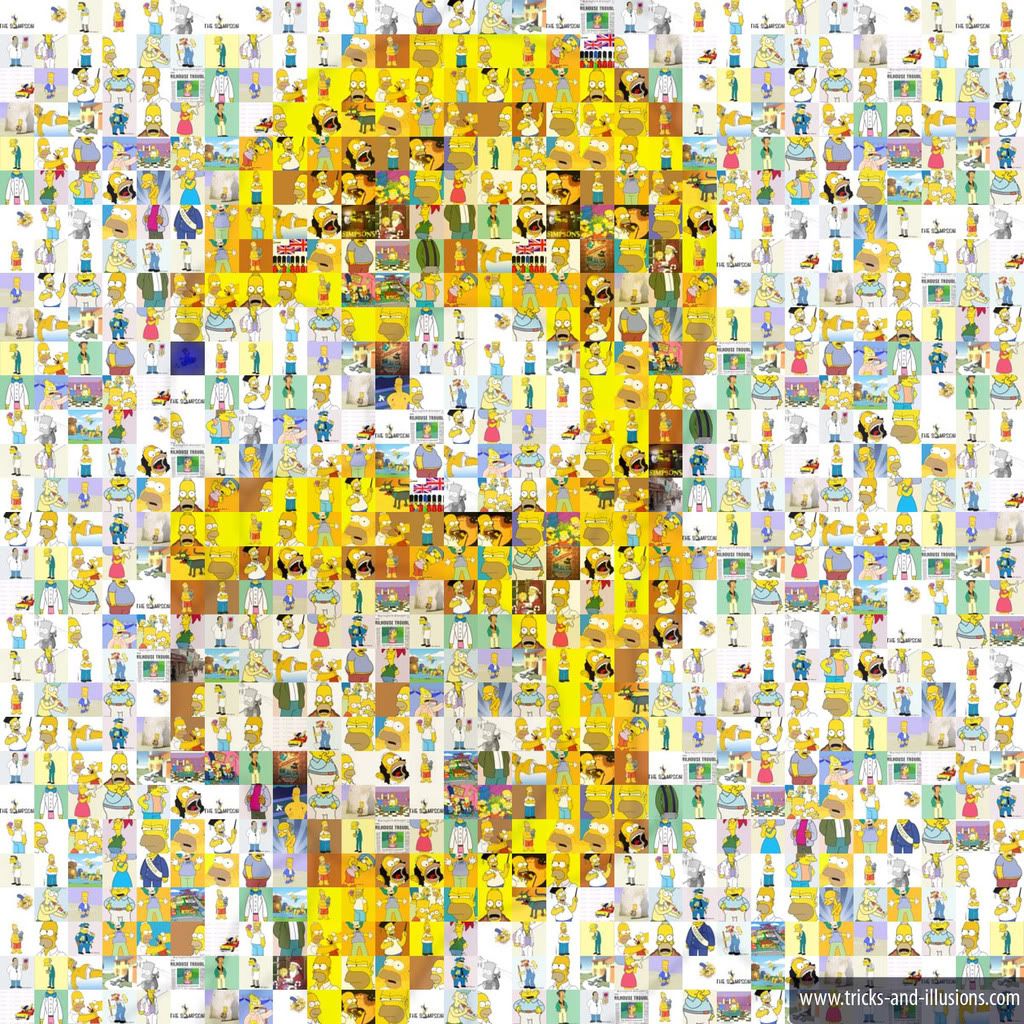
This picture of Homer Simpson surrounded by many other smaller pictures is similar to many mosaics of great people, including Babe Ruth like Livingstone showed, and shows how our peripheral vision (with low resolution) and central visions (with high resolution and more detail paid attention to the center) work to perceive the individual snapshots separately from the bigger, macro portrait of Homer.
Closely related to this is the idea of optical illusions, and somewhat related to the 3-D images that Livingstone discussed. The way we perceive the colors and depth of these dice is different depending on what angle we look at them from, the colors used, in this case, the stark contrast of black and white, the background they are on, and the shadow it creates. We saw examples of these illusions in class as well, and some are more abstract with just colors and shapes, where others can be actual objects that deceive us. With color illusions, what we see is more an illusion of motion, while with objects such as the dice, the illusion is one of depth and 3-D.
Thursday, February 12, 2009
WISER/Sherryl Broverman
First off, I think that the whole idea and perspective of WISER is great with a great intiative and idea/mission. It touches so many aspects that are important to girls and women growing up in Africa (specifically Kenya), which in turn affect the society as whole. It's great that people are the world are working to want to improve places that they may have no direct connection to, but still want to see succeed. This is especially true because especially in areas such as Nyanza, women do not have as prominent a role in society, and to be able to help them achieve better lifestyles, become literate, healthy, etc. is important. At the same time however, it will probably take more than just one organization, and one girls' school, and the start-up money they have to help the situation, especially in the poor, male-dominated region, but it is definitely a stepping stone that has an impact.
I thought Sherryl Broverman's lecture was really interesting, especially in noting how Kenya is very technologically advanced in many ways, for being as poor as it is and not having some basic necessities. It just kind of shows how priorities have changed these days. However, this is mainly the case for males - women in Kenya (and much of Africa) don't receive the same privileges, which is where WISER steps in as a way to make things more available to women and equal. As Ms. Broverman said, trying to do this - to make women aware of political issues, health issues, economic issues, etc., through introducing and allowing women access to more technology, is an effective way to do so because of the pace at which things are changing not only in Kenya, but worldwide. I also thought that websites with different initiatives such as Ushahidi.com to be updated and connected to others, and Kiva.com where people all over the world can donate money to help advance Africa, were other sources that could be very beneficial to the process. I think that one of the biggest things I took away from the lecture is how much we take technology for granted here (in the U.S.), by seeing how it is so empowering in places like Kenya, especially in terms of gender roles between men and women, and how it is beginning to change so many aspects of society for these people, whereas here we are "behind" if we aren't already adapted to it.
Wednesday, February 11, 2009
Medicine in Technology/Mark Olson
I thought the connection this week between information technology and medicine, both through the articles we read and through Mr. Olson's lecture were really interesting and sparked some ideas I hadn't really thought about before. The idea of robots taking on the roles of doctors and nurses to advance medicine and health in replacement of humans, and even surpassing the skills that humans have is both cool and scary. On one hand they are able to do things just as, if not more, efficiently and accurately than human doctors. On the other hand, while these robots can take on more than humans may be able to, they cannot adapt to a situation, and therefore if something goes wrong or there is something they are not programmed for, it could turn out with really bad results. Also, the robots themselves are not fullproof and could therefore malfunction themselves, which could also have a negative affect through their medical procedures.
Mr. Olson's discussion of the Da Vinci Surgical System was cool because it expanded on what I have heard of on the technological advancements in medicine and computers as doctors thus far. There are clearly many benefits to having robots/machines performing the procedures and medical assistance, but I am not sure that they should be the only option in the future - working in tandem with human doctors is necessary, not only for personal contact but also in the event that the robot may be unable to function if something goes wrong, or fix something if it goes wrong. At the same time, the skills (and knowledge) of the human doctors will decrease, because they won't have to know these things off the top of their heads any longer, and eventually may not be needed at all - which could be very bad for employment purposes! However, it may also open up different opportunities, both in terms of jobs, where new ones will be created to adapt to the new technology, but also in having the ability to perform surgeries worldwide without having to be present. I think that there are a lot of possibilites that open up with the introduction of robots and machine-performed surgeries in the medical field, but at the same time I don't think we should rush right into it because there are many risks and consequences that come with it.
Wednesday, February 4, 2009
Virtual Peace/Patrick Herron
I thought Patrick Herron's lecture was really interesting and his work with Virtual Peace was really intriguing. I was kind of unclear at first about the purpose of Virtual Peace and what kind of impact it has as a virtual space, but after hearing the lecture and other points Mr. Herron brought up I think it's a really good idea. Mr. Herron's explanation/thoughts on simulation vs. reality were also interesting (a little confusing at first) but he did make good points with good evidence to back up that convinced me! I think that having simulations like Virtual Peace, that are educational but still engaging and still "games," make them more appealing. I also think that they are better than the paper-based version like Mr. Herron was saying, because it allows students to get other input and ideas, interact, and not just have set instructions, rules, and thoughts on paper.
The fact that it can provide the future generations, but also adults now, with ideas and real-life situations on issues in the world can really help for future conflicts, so I think that's a big plus. I think having more conflicts and issues other than one focused on Hurricane Mitch, but for other current problems today as well as past ones would really be beneficial to learning. It might be cool to maybe try a more broad-based simulation that can accomplish this, for various conflicts, which would allow everyone around the world to interact and get all sides of the conflict involved, for example with the Israeli-Palestinian conflict, or the War in Iraq. The problems of time and money come into play too with this however, so I don't know how realistic/plausible it would be.
--
Playing with Virtual Peace today was pretty cool, but a little different than I expected. I guess because we were just playing around with it and not using it for the "intended" purpose exactly, but I still thought it was a cool idea. If I were to play it for a class it would be a lot more interesting and engaging, and I think I would really learn a lot along the way. It is definitely much more engaging and fun, especially for our generation, to learn through simulation, and actually doing, than just reading and listening. It was funny to play that and then Second Life right after, seeing how the overall "world" compared to this simulation for a conflict in the world. It was also cool to see how everyone was interacting and how they recreated themselves in this virtual world, whereas in Virtual Peace it was a very professional and preset. Overall I thought that using both simulations was a cool exploration to show where the digital culture is shifting and becoming more user interactive, 3-D and influencing future decisions.
Sunday, February 1, 2009
Guest Speakers & Metaverse/Second Life Articles
I thought both the two guest speakers this week were really interesting and brought about cool ideas that we hadn't really seen/considered yet in class. The GUIs that Mr. Lombardi discussed was interesting because I didn't really know much about it or really consider it. The Colbalt/Croquet 3-D Internet project that Mr. Lombardi showed us was cool, but perhaps a little impractical for the future. It's cool though that not only because it would be able to connect users all over with more up-to-date information and just more efficient overall, plus it makes it more personal - at the same time though, people might not like this because it gets more invasive of their privacy and exposes their identity, and it also creates a lot more extra information to be sorted through. People might also feel they can be just as personal with webcams, audio programs, etc. But then again people also like being more involved and being able to re-create themselves online as an avatar in another "world," etc. is appealing. I also think however, that avatars are used more for people who have a lot of time and like the more video-game aspect of spaces like Second Life, and therefore like the fact that things are in 3-D and seem more "real" then just normal internet surfing of websites and games. I think it's also a cool idea, yet again a little unpromising for the future, that companies are starting to make virtual worlds for their companies, because in a way it's just like advertising but in a more interactive, personal way, which appeals to people - especially those with a lot of time surfing around. Mr. Seaman's lecture was also interesting because it showed another different side to virtual spaces but in terms or art/literature, and how these are combining. The combonotoric systems and recombinant poetics and the way that's changing the way we interact with art and was cool and something we hadn't really seen yet so I thought that was interesting as another aspect to how we are getting more interactive with technology.
Wednesday, January 28, 2009
Second Life & Google Earth
After I made my avatar, I was almost overwhelmed by all of the things I could do on Second Life. It's funny how addictive these kinds of things can be, and how I wanted to explore every aspect of it. I spent so much time just fixing my avatar herself, which was fascinating, to see all the different things they think of to include about a person - facial features, body features, etc. Going through the different areas, I was really unsure of how to go about everything, interact with the others, see what they were doing, where I could go, etc. - a feeling I get in real life too! It was cool to be able to make my character do different things, especially fly, since that's not something we can really do.
I thought that the overall interface of Second Life was also part of its appeal - it has a futuristic look, and everything in it is so accessible assuming we know what we want - as Dr. Lombardi mentioned in his lecture. I teleported to different places such as New York City (since I'm from there, I wanted to see how it compared of course!), and went around through Times Square, which was cool. Met a few wackos, which is just like back home, haha! I also went to a few clubs in Las Vegas - good party scene! I got kind of confused at times because the scene would have to build up as I went along it, so I would get kind of lost in where I was, but I think using it more and exploring different areas will help to become more familiar with what to do, where to go, etc.
Google Earth is one of the coolest things I think we have been able to generate. The ability to see any spot on Earth is crazy. We actually used it today in one of my classes when discussing different cities around the world, and to see them all there back to back(without having to travel!) was impressive. This global Metaverse allows people everywhere to see what other places are like around the world without having to go there. If Second Life and Google Earth were to combine it would allow interaction between users from everywhere not only in a virtual space, but to actually see what it is like elsewhere and explore.
Wednesday, January 21, 2009
Wikipedia
I edited the twin page on Wikipedia (I figured it was relevant to me, since I am one, so I could put in my two-cents). It was interesting to see some myths about twins that I edited out, and I also better organized the different kinds of twins there are and how they are "created" - there was a lot more "biology" about twins on the page that I didn't know about, so clearly I can't say if that was true or false.
Web 3.0
I wasn't in class on Tuesday to hear Paolo Mangiofico, so I might have missed a little, but reading these two articles about the new 3.0 internet was kind of a follow-up to what I was researching last week. One of the interesting things I read in the articles was how Web 3.0 has changed from 2.0 and 1.0 - from "read only" to "read-write" to "read-write-execute" (Wikipedia), and therefore becoming more user generated. Two other things I think that are cool to think about as future "prospects" of Web 3.0 are 3-D spaces, and how the internet is predicting the future with all of this information, which at the same time may not all be true, but nonetheless guides the creators on what people are looking for to enhance the internet.
The first article that discussed the economic aspects of the web were interesting, because I always wonder how all of these sites such as Google and Facebook etc. can make so much money, when they are putting so much information and connections out there, but no one is paying. So even though these networks are the most popular things in the world, advertising and marketing still comes heavily into play. It's interesting that some of the companies don't even have business plans for their networks, they just execute the idea first and see how it goes and expands, and then figure out how to take it. It's almost as if we know anything we generate online now can make money, we just have to figure out how to cater it to what people want and then get the money from there.
Wednesday, January 14, 2009
The Future of Social Media
"Tim O'Reilly on the Future of Social Media"
Tim O'Reilly discussed technology's future as it will be in terms of social networks. He established "Web 2.0," a reflection of the idea that everyone thought the web was dead after the dot com bust, but is actually back (thus 2.0, the return of the internet, the second version, even thugh it never really left/died). The companies that survived the bust and were created after it understood how to network, which is now essentially the platform for the computer industry. Social networking brings not only the information to the web, but has the power of connecting people, and as O'Reilly says, is the "design of systems that get better the more people use them."
So does that mean the internet as we knew it before social networking was so big will disappear? On one hand social media is not just how users explicitly share information about themselves, but also how the company's collect, input, use and interpret data about peoples implicit behavior. There are social networks like Google and Wikipedia that we wouldn't automatically consider social networks in comparison to the new "set standard" of social networks like Facebook and YouTube. However, these are just as effective social networks because they link people for better searches based on the users' collective preferences, and the information is often (and always in the case of Wikipedia) information brought in by the users. These sites are therefore based on what the users implicitly want. As a result, the user generated content is used to build large databases that allow new things to be done with the internet. So while new applications are driven by socially created databases, they are not necessarily explicitly social.
The obsession with having to know what people we care about are doing, curiousity of instigating the lives of people we are not close with, etc. is always combined with the question of how much information is too much for everyone to see and always know. Why do we always care about every detail of somone's life - if they're showering, eating, partying, etc.? And why is everyone so anxious and willing to give out this information that we don't really need to know? In a sense it creates better personal connections and we always know the most up-to-date information. There is also the issue of social media as a disctration, taking over and taking away from more important, necessary things, because we are too caught up in continuing to be updated on minor details.
Social media is not just exploding through Facebook, YouTube, Google, etc., but it is also spreading in use by the government for polls, surveys, etc., and coming to the end of the personal computer era and able to come with us everywhere (i.e. iPhone, Blackberry, etc.). However, this increases the fear that everyone's knowledge is out in the open and able to find things out that used to be secret, or are potentially bad and we do not want in the public. At the same time, it makes us have to adapt our behavior and get used to new standards of visability, seeing things for the first time, but eventually having them repeat and becoming the norm.
Sunday, January 11, 2009
Articles for 1/13
The two articles I found most interesting and relevant were "How Your Creepy Ex-Coworkers Will Kill Facebook" and "The Autumn of Multitaskers." I think it's true that the trend in the expansion of social networking through the internet has altered the way friendships/relationships work in the "real world." I hadn't really thought about why it is we jump from service to service, I kind of just figured it was because there was a new and "improved" way to be even more connected with even more people that we switched. But in a way I guess eventually Facebook will have to die out and be replaced by a new service; not just because it's more "superior" to the former service, but also because, as the article explains, being connected to people that you normally wouldn't be in the real world can create awkward and unneccessary situations. At the same time however, it can put people back in contact and has a lot of positives to it. Although Facebook itself won't necessarily "take over the internet," now that social networking sites online have been established, they will only get upgraded and improved, so they will never go away. Aside from these social networks, as a big fan of multitasking myself, I understand the concerns over the negative affects it has, but I think everyone is prone to it in one way or another, and it can at the same time be very effective. With the expansion of the use of the internet and technology, it seems fit that one of the definitions given for multitasking is a way for people to act like computers, often using computers. The term still existed before computers were around, but now its been changed to fit how we interact with new information and technology.
Friday, January 9, 2009
About Me
Hi everyone! I never really know what to say for these things but here are a few things about me. I'm from New York City and I'm a freshman. I don't really know what I'm going to major in yet, but since I don't really think I want to do computer science, but because I'm still interested in the field, I think ISIS is the perfect alternative. I'm a pretty creative person and since I love to be online and dealing with new information and technology it's cool to put it all together. I also love sports (all the New York teams of course!), and I played basketball and softball for 10 years. Now I work in the Duke Sports Information office which is fun.
P.S. I have a twin sister who also goes to Duke, so you might get us confused!
Subscribe to:
Posts (Atom)